
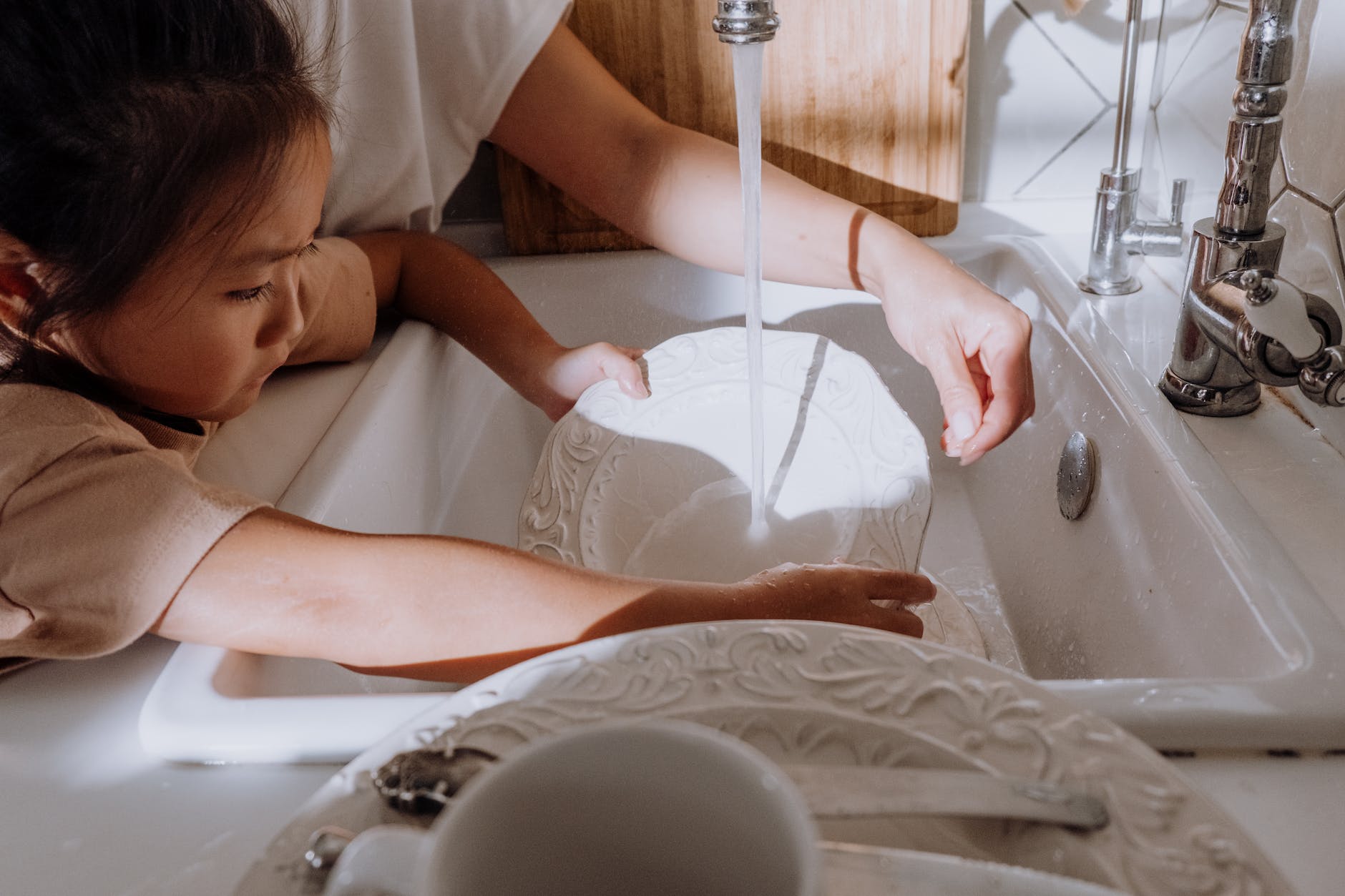
On the Australian Parenting Website, Raising Children, it states that:
“Doing chores helps children learn about what they need to do to care for themselves, a home and a family. They learn skills they can use in their adult lives, like preparing meals, cleaning, organizing and gardening.
Being involved in chores also gives children experience of relationship skills like communicating clearly, negotiating, cooperating and working as a team.
And when children contribute to family life, they might feel competent and responsible. Even if they don’t enjoy the chore, when they keep going they can feel satisfied that they’ve finished the task.”

My daughter has been given the chore of setting the table and getting the drinks at dinner time. At first it was a little difficult to remind her to do the task – it had become habit for me to do it myself, but now that we are in the routine of it, she actually seems to feel quite proud to be contributing to the family and has even asked for more chores to do!
In my opinion there are 3 categories of chores:
- Those that contribute to the running of the family
- Those that earn a monetary reward
- Those that have a non-monetary incentive
My daughter setting the table falls into the first category and really seems to elicit the experiences described on the Raising Children website.

We are going on holidays at Christmas and my daughter is after more spending money, so in order to achieve this we are looking for tasks to fall into the second category. My husband and I initially decided to set her the chore of emptying the lower half of the dishwasher and we would give her 50c each time. But then I was talking about it with a friend and she pointed out that we would love my daughter to continue emptying the dishwasher after the holiday, not just until then. Excellent point! This chore would be more appropriate in the first category. As an alternative we could make up chores of cleaning out the cutlery drawer, vacuuming the inside of the car, dusting the skirting boards or doing some weeding. These are all once off tasks that may reoccur some time down the track that can earn some extra reward for being completed.
Finally, the third category; chores that have a non-monetary incentive. I think this category is very important. I think that children need to learn that not everything is about money. Often in life it is about balancing give and take in relationships and you can do things for others without expecting payment or calculating who owes what or who has done the most – it is more unmeasured. At a young age there may need to be some kind of material incentive, for example doing jobs to earn a ride at the show, or having an extra playdate with a friend. I am hoping that as my daughter gets older she will want to do things just to be helpful and to make others happy. She is already showing signs of this which in turn makes me happy and proud!
For a list of suggestions of which chores are suitable for children of different ages see the raising children website Household chores for kids

Chores are a given part of life for everyone. We are all introduced to them at a young age and develop our skills as we grow. As we move through life and our circumstances change so do our chores and what is expected of us. Starting chores as a child is a great set-up for what is to come!
About the Author
Sally is a home organisation and budgeting expert with a passion for helping families take the stress out of everyday tasks by creating simple, efficient and cost-effective processes. Her strategies can result in more time and energy being available to spend time doing what you love. Sally is a quiet budgeting queen, home organisation specialist, wife, mother, animal-loving mathematician and so much more.

Leave a Reply